Polar
An open-source merchant of record for developers: payments, subscriptions, usage-based billing and global tax
1.1MB · 14,919px tall · uses PP Neue Montreal, GeistMono
About the site
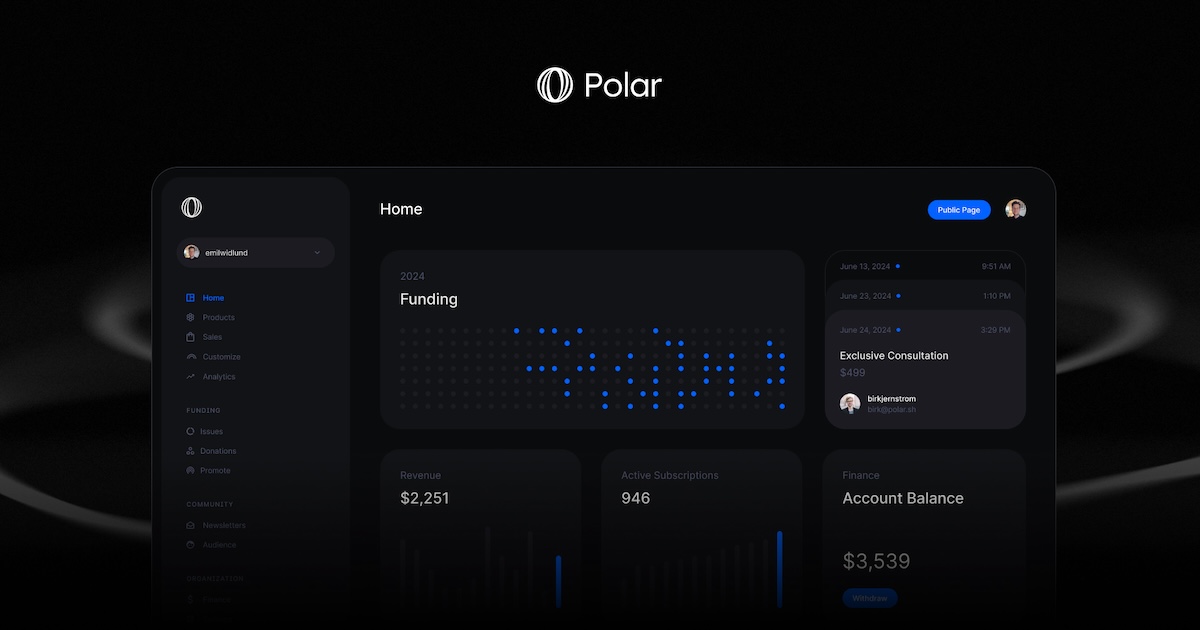
Polar is an open-source merchant of record for developers building AI-era software. It handles payments, subscriptions and usage-based billing, and as the legal reseller it takes on sales tax, VAT, fraud and chargebacks in over 100 markets. The homepage is almost entirely black with soft grey type, and each feature is shown as a precise product card floating on a grainy, monochrome field of rippled light. It opens on 'Meet Polar / Modern billing for AI companies' beside a margin dashboard (61% gross margin, $18,451.50 revenue against $7,114.99 inference cost), then works through five numbered chapters: Usage Billing, Charge, Understand, Sell globally and Agents. An early-access usage engine, quotes from Guillermo Rauch and others, four-tier pricing with fees printed in full and a free first year for startups follow, before a spiral of the word POLAR and 'From usage to revenue. Integrate in an afternoon.' Putting the transaction fees on the homepage is unusually candid for a payments company.
How this page sells
For developers selling AI products: show the margin dashboard they want, then remove tax and billing work chapter by chapter.
Primary navigation
- Features
- Docs
- Blog
- Company
- Sign In
- Get Started
ClickTap a section to see it on the page
'Meet Polar / Modern billing for AI companies' above a dark dashboard on a grainy grey field: Acme Inc's 61% gross margin, $18,451.50 revenue against $7,114.99 inference cost, metered llm.completion usage and a $20,950.50 next charge.
Why it converts: AI companies worry about inference eating margin, so a dashboard that shows revenue and model cost side by side sells the outcome before naming a feature.
'Trusted by leading AI companies' beside a Stilla AI quote: 'The Polar team treated us like a design partner, not just a customer… That's rare.'
Why it converts: A quote about responsiveness speaks to the startup fear of being ignored by a payments provider, which matters more than logos at this stage.
'Everything you need to sell / One platform, from checkout to payout' with a scrolling row of line-art cards: Usage Billing, Subscriptions, Merchant of Record, Seats, Trials, Discounts, Cost Insights and Finance.
Why it converts: One carousel covers every pricing model a buyer might need, so nobody leaves thinking Polar only fits one way of charging.
'Every token becomes revenue the moment your model streams it' with an events.ingest() code card ('Added to invoice $0.0024') and three steps: Measure the usage, Aggregate into meters, Bill it automatically.
Why it converts: A single line of code turning a token into money makes usage billing feel trivial to implement, which is the developer's real question.
'One invoice for everything' shows credits and a $3,783.30 invoice; 'Know your margin for every customer, not just on average' shows a margin table where one customer, Atlas, runs at −37%.
Why it converts: Showing a customer who loses money is a sharp, specific pain, and the table proves Polar answers which accounts are worth keeping.
'Polar as the merchant of record / the liability lands on our name, not yours' with a €2,735.81 order in Berlin: payment captured, fraud screened, 19% VAT calculated and remitted, $2,412.60 paid out.
Why it converts: Global tax compliance is the hidden cost of selling software abroad, and taking on the liability is a risk transfer a small team can't get elsewhere so easily.
'Billing, set up by your agent / Three commands from install to checkout' with a terminal card installing the Polar CLI and agent skills, then a claude prompt that sets up products, checkout and webhooks.
Why it converts: Letting a coding agent wire up billing meets developers where they already work and makes 'integrate in an afternoon' believable.
'Agent-first billing, in early access' with a grid of ten line-icon tiles from Billing as code to Bring your own PSP, a field guide link and Request early access.
Why it converts: Previewing the next engine shows a company building for where AI pricing is heading, which reassures buyers making a long-term infrastructure bet.
Guillermo Rauch of Vercel: 'The speed at which Polar is executing on the financial infrastructure primitives the new world needs is very impressive,' above quotes from Stilla AI, Mitchell Hashimoto and FastAPI's Sebastián Ramírez.
Why it converts: Endorsements from developers other developers follow carry more weight with this audience than any enterprise logo wall.
Four tiers with fees in full, from Starter (Free, 5.00% + 50¢) to Scale ($400/month, 3.40% + 30¢), then 'Your first year is on us / the Scale plan, free for twelve months' for early-stage AI startups.
Why it converts: Printing exact fees removes the usual payments-pricing suspicion, and a free year lowers the switching cost for the startups Polar wants early.
A spiral of scattered 'POLAR' letters above 'From usage to revenue / Integrate in an afternoon' and a white Get Started button.
Why it converts: The typographic spiral gives the end of a dense page a moment of calm, and the afternoon promise restates the low effort one last time.