


Sarvam
AI Infrastructure
Cloud browser infrastructure that lets AI agents use the whole web
4.0MB · 7,322px tall · uses Times, plain, gtStandardMono
Industry
AI Infrastructure, Devtools, AI Agents
Style
Illustrative, Minimal
Stage
Series B
Built with
Next.js
About the site
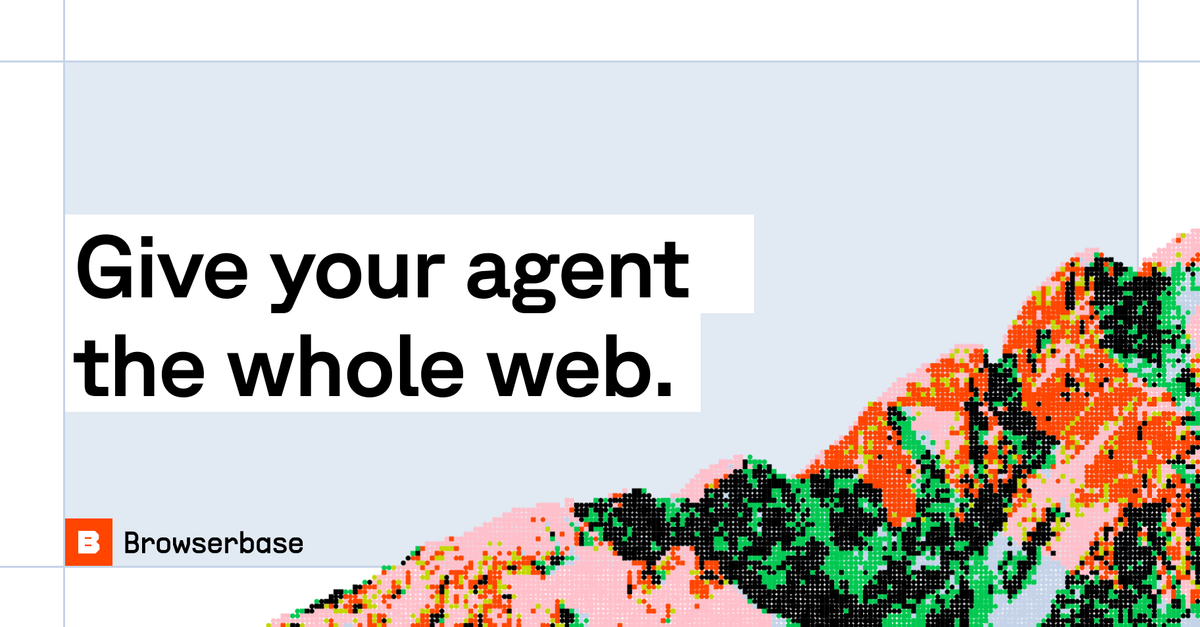
Browserbase runs headless browsers in the cloud so AI agents can log in, click, fill forms and pull data from sites that have no API. The homepage sets its headline in orange highlight bars over pixel-art mountain ranges, and the same 8-bit landscapes return in the setup steps and a closing '10,000+ years saved' panel. In between, grey product mocks walk one flight search through the Search API, Fetch API and a live browser, eight line-drawn cards cover jobs from solving CAPTCHAs to tracking prices, and a lime template card points to the open-source Stagehand SDK. A strong reference for developer infrastructure that wants a warm, memorable visual identity without losing technical credibility.
For teams building AI agents: sell the browser as the API for sites that have none, then prove it with product mocks, templates and adoption numbers.
Primary navigation
ClickTap a section to see it on the page
'Give your agents access to the whole web.' in white on orange highlight bars above a pixel-art mountain range, with 'Browserbase makes the web as reliable and programmable as APIs' and Get API key and Setup for agents buttons.
Why it converts: One line names the buyer (teams building agents) and the job (reach any site), and both buttons start a developer on the product instead of a sales call.
A row of logo tiles for Microsoft, Clay, Amplitude, Ramp, Lovable and DeepMind, most with a mono 'Read the story' link underneath.
Why it converts: An AI lab and fast-growing AI startups signal that serious agent teams run it in production, and the story links give a champion material for an internal case.
Search API, Fetch API and Browser-as-a-Service each sit beside a grey mock of the same trip: 'Searching for roundtrip flight from SFO to NYC', a Skyscanner page returned as markdown, then a booking page.
Why it converts: Following one flight search through all three products shows how they fit together on a real task, which a list of endpoints never does.
A yellow-highlighted headline beside a pixel-art computer, 'The browser is the web's native interface', and a mono checklist: 'Handles auth, flows, dynamic content', 'Adjusts to updates and changes', 'Works everywhere'.
Why it converts: The checklist names the exact reasons scrapers and scripted automations break, so a developer who has lived through them reads it as the fix.
Eight line-drawn cards such as 'Access the 85% APIs can't reach', 'Unblock agents that get stuck' over a CAPTCHA box, and 'Watch the whole web at once' over a hotel price drop, each with Get started.
Why it converts: Each card is a different buyer's job (QA, research, form filling, monitoring), so visitors find their own use case and a link to start it.
A list of plain-English tasks ('Monitors trending keywords on Google', 'Enables your Claude Code to use the web', 'Verifies business registries for KYC') beside a lime card with Try template and Stagehand SDK and Browser CLI chips.
Why it converts: Starting from a working template for a recognisable task cuts the time to a first result, and the open-source chips ease worries about lock-in.
Three steps over bright pixel-art landscapes: 'Create a browser session', 'Choose your model' through a Model Gateway diagram, and 'Execute your first task'.
Why it converts: Three steps with no infrastructure to set up tell a developer the first run takes minutes, which lowers the cost of trying it.
A bordered band, 'No obstacles for your agents. No limits on what they can accomplish.', with a black Try for free button next to a grey Talk to sales.
Why it converts: Two exits side by side catch the developer ready to test and the enterprise buyer who needs a conversation, without making either scroll to the end.
A green pixel-art mountain behind '10,000+ years saved' in huge type, labelled 'Human years browsing the web'.
Why it converts: Turning browser sessions into human years saved converts infrastructure usage into a labour-savings story a budget holder understands.
Four pastel stat tiles, '800,000 weekly SDK downloads', '100,000 developers', '10,000 companies' and 'Millions websites visited', above an orange footer with a giant B mark.
Why it converts: Weekly download counts show live adoption among developers, the people whose choice of tool usually decides the vendor.

AI Infrastructure
AI Infrastructure
AI Infrastructure
AI Infrastructure


