Rig
Security verification for AI coding agents: finds vulnerabilities as agents work, guides the fix and checks it again
0.1MB · 8,588px tall · uses Times, Instrument Sans, Chivo Mono
Industry
Style
Stage
Built with
Custom
About the site
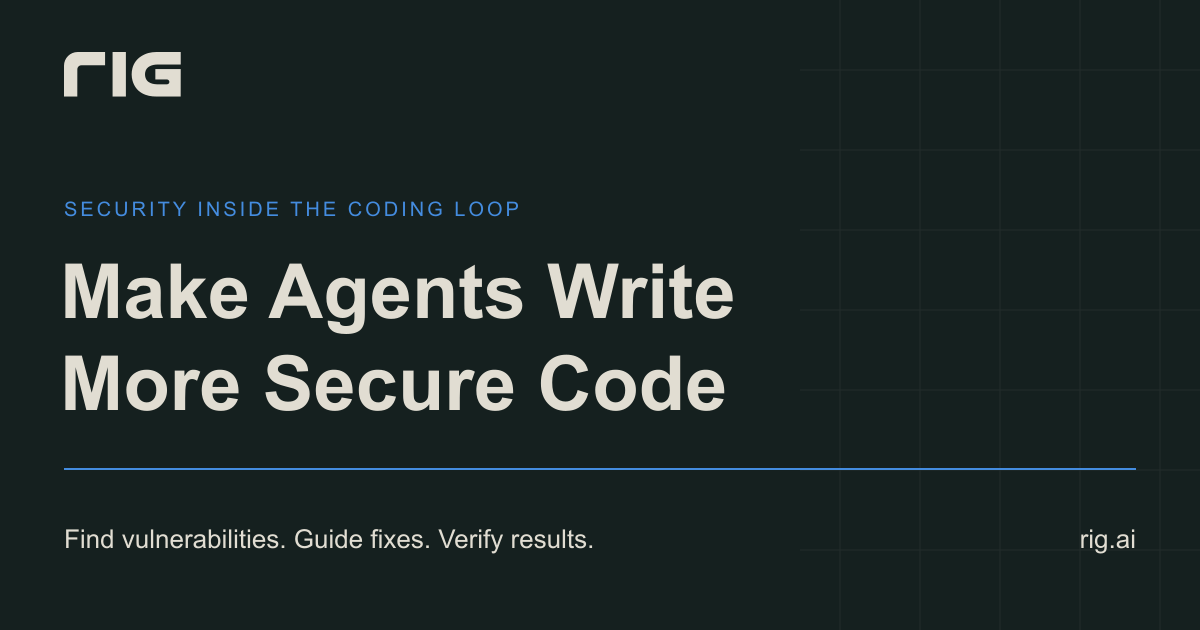
Rig is a security tool for AI coding agents. It runs locally, hooks into an agent's completion step in tools such as Claude Code and Codex, checks each change for vulnerabilities, sends findings with fix guidance back to the agent, and rechecks the result before anything reaches review. The homepage looks like a retro terminal: a bright blue hero with 'Build Security Into The Agent Loop' in heavy grey type and a news ticker of AI security headlines, then a charcoal page layered with fixed scanlines, noise and an RGB fringe like an old CRT. Each section sits in a hairline grid with numbered monospace labels: the four risks of agent-written code, a four-step loop demo (Hook, Check, Fix, Recheck) with play controls, a before-and-after SQL injection fix, benefit and setup grids, an FAQ and a closing 'Ship Confidently' over a blue wireframe terrain. The CRT treatment makes a security product feel hands-on and technical rather than corporate.
How this page sells
For engineering leads adopting coding agents: name the new risk, then show security fixed inside the agent's loop, not in a ticket queue.
Primary navigation
- Docs
- GitHub
- Install Rig
ClickTap a section to see it on the page
'Build Security Into The Agent Loop' in heavy grey type on bright blue, with 'Find vulnerabilities as agents work… before findings turn into tickets,' Install and Docs buttons, and a ticker of AI security headlines.
Why it converts: Placing security inside the agent loop is a new category claim, and the live headlines ticker supplies the urgency without Rig having to argue it.
'AI is an Asset and a Risk' as a four-cell grid: More to Review, Hackers Are More Dangerous, Your Backlog is Growing, and False Positives Obscure the Reality, beside a diagram of PRs piling up before Ship.
Why it converts: Naming four pains a security lead already feels, including false positives from existing tools, builds agreement before the product appears.
'Automated Security Inside the Loop' over an editor mock: an agent adds a search endpoint with a raw SQL query, and a Rig completion hook starts 'Checking the code change…', with Hook, Check, Fix and Recheck steps and a Play control.
Why it converts: Watching the check run automatically when the agent finishes shows that nobody has to remember to scan, which is the core of the pitch.
'Clear Findings. Actionable Fixes.' compares the issue (a SQL injection in WHERE name = '${name}') with the fix (a parameterised query), labelled 'Keep input separate', above Know where to look, Understand what matters and Check the change.
Why it converts: A concrete before-and-after diff shows findings an agent can act on, which contrasts directly with the noisy alerts of older scanners.
'Security Checks That Keep Work Moving' as three steps (Check the Code, Guide the Fix, Check Again) beside a flow diagram from Code change to Finding and fix to Recheck result.
Why it converts: A three-step loop is simple enough to explain to a team in one sentence, which makes trialling it an easy decision.
'Fewer Vulnerabilities Reach Review / Find and fix vulnerabilities while agents work in minutes, not weeks or months,' above three cells: Catch More, Chase Less and Ship More.
Why it converts: Framing the benefit in the time a team gets back speaks to engineering managers who measure throughput, not just security metrics.
'Set up Rig where the code gets written.' with Install the CLI, Connect the coding agent and Run the first check, then 'Works with your stack' icons for Codex, Claude Code, VS Code, Python, Rust and GitHub.
Why it converts: Running locally beside tools developers already use removes the procurement and data worries a cloud scanner would raise.
'Frequently asked questions.' with six rows such as 'Who makes the code changes / fixes to reported vulnerabilities?', 'Does a clean scan mean the entire application is secure?' and 'Will Rig Collect my Data?'
Why it converts: Answering the honest limits ('does a clean scan mean secure?') builds trust with security people, who distrust tools that overclaim.
The blue Rig mark above 'Ship Confidently' in large type over a blue wireframe terrain, with a slanted 'Install Free' button, then a footer reading 'All systems local'.
Why it converts: Ending on confidence rather than fear, with a free install, makes the first step feel risk-free for a developer.