V7
AI Agents
An analytics platform where data teams and AI agents answer questions with governed, trusted data
1.9MB · 10,661px tall · uses Times, Cinetype, Cinetype Mono
Industry
Data, AI Agents
Style
Typographic, Bento, Minimal
Stage
Series C+
Built with
Next.js
About the site
Hex is an analytics platform that combines notebooks, conversational AI, data apps and a managed context layer so business users and data teams get consistent answers. Its homepage sits on a faint graph-paper grid with a scrolling announcement ticker, pairing a heavy grotesk with a swashy italic in 'The Analytics platform for humans and agents.' A logo wall of AI-era customers (Anthropic, Cursor, Ramp, Notion, Figma) leads into an interactive agent demo answering a sales question with a chart, then the same thread in Claude, Slack and a CLI. Sections on compounding context, prompt-built dashboards, an evals and observability studio, model choice and enterprise security each carry a named customer quote, before customer stories with G2 badges, an integrations grid (Snowflake, dbt, GitHub, Airflow) and an FAQ. A useful reference for keeping a dense, multi-product page readable through one consistent grid, real product UI and a quote beside every claim.
For data leaders replacing legacy BI: prove AI answers can be trusted, with live agent demos, governed context and a customer quote beside every claim.
Primary navigation
ClickTap a section to see it on the page
'The Analytics platform for humans and agents' mixes a heavy grotesk with a swashy italic over graph paper, with pill chips for BI, Conversational analytics and Context management under a scrolling announcement ticker.
Why it converts: Naming agents alongside humans recasts a BI tool for the AI era, and the chips map the three budgets a data leader is already weighing.
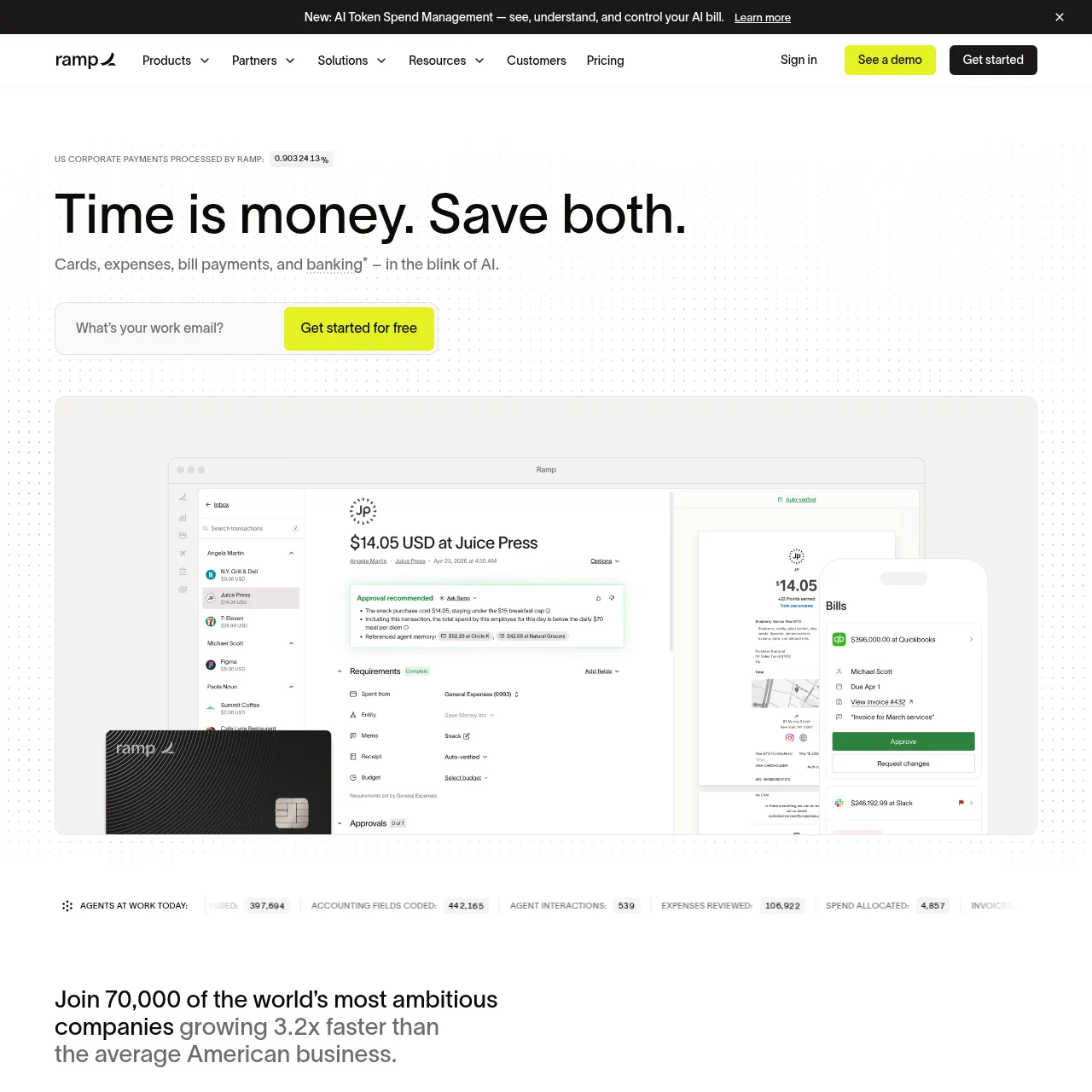
'Trusted by leading data companies' lists Reddit, Notion, Sierra, Anthropic, Lovable, Ramp, Rivian, Figma, Brex, Cursor and AWS, among others.
Why it converts: AI-native companies choosing Hex signals that it fits how modern teams work, not just legacy reporting.
'BI tools, chat apps, and vibe-coding only give you inconsistent answers' leads into an agent thread charting a fictional company's Q3 revenue, echoed in Claude, Slack and a Hex CLI window.
Why it converts: Naming every alternative's flaw at once frames trust as the real problem, and the same answer appearing everywhere shows Hex meeting people in their tools.
'Ground every answer in your organization's context' circles a 'Compounding context' loop of building apps, sharing context and auto-detecting gaps, with a Zoe staff data engineer quote.
Why it converts: A context layer that improves with use is the moat a chat-over-SQL tool lacks, and the loop makes that abstract idea visible.
'Share insights with generative dashboards and data apps' shows four prompt-built tiles: a US demand map, $550k subscription revenue, a $428k forecast and 283 accounts, each tagged with its prompt.
Why it converts: Pairing each polished dashboard with the one-line prompt that made it shows how little effort a useful app takes.
'See what people are asking, and whether the answers are right' layers an agent observability dashboard (461 conversations) over an evals table grading answers, beside a quote from Chime's data science director.
Why it converts: Showing how answers get graded and monitored speaks to the data team's real fear, being blamed for a wrong number they didn't write.
Two cards: 'Work with any data, any AI model, and any context, so you aren't locked in' opens on 'Your AI bill is getting big', and 'Secure your data with enterprise-grade permissions and trust' links to the Trust Center.
Why it converts: Model choice, spend visibility and enterprise security answer the objections a CFO and security reviewer would raise before signing.
Mercor: 'If we didn't have Hex, we might've left more than $100M on the table.' Algolia: 'It makes me 10x faster.'
Why it converts: A nine-figure claim and a productivity multiple turn a tooling choice into a business case a buyer can repeat upward.
Story cards from Notion, Mercor, Figma and Neo sit above six G2 badges ('Users Love Us', 'Best Est. ROI') and a Notion engineer's quote about anyone answering their own data questions.
Why it converts: Named stories with specific outcomes let each buyer find a peer, and the badges add independent validation.
'Instant integration with the whole stack' shows line-drawn cards for warehouses (Snowflake, BigQuery, Databricks), dbt, OAuth, GitHub and GitLab, Airflow and Dagster, and the Hex API.
Why it converts: Seeing their existing warehouse and pipeline tools named removes the fear that adopting Hex means re-plumbing the data stack.
'Getting started is easy.' offers 'Get started for free' or 'Talk to us', then an FAQ asks how Hex differs from ChatGPT, Claude, Codex or any other AI assistant.
Why it converts: Free and sales paths serve both self-serve analysts and enterprise buyers, and the FAQ takes on the cheapest substitute directly.